Jun 26, 2026
By Stephanie Eckroat
Many customers walk up and ask, “So is it buffalo or bison?” Around here, both words have been used for generations, and most folks still say “buffalo” without thinking twice. When I sat down with Luke Yearout and Brooke Williams, I mentioned the children’s book “Buffalo Fluffalo,” and they both immediately laughed — they knew exactly what I meant.
That small moment captured something bigger: how bison ranching connects generations, from adults who reminisce about old prairie herds to kids discovering the animals for the first time. It’s the same connection that fuels Luke and Brooke’s passion as third‑generation ranchers behind Southern Plains Bison Company, honoring their family’s past while building a future in south‑central Kansas.
When I asked them about the difference between beef and bison, they did not try to declare a winner. Instead, they talked about how the two meats simply offer different eating experiences. Bison, they explained, is naturally leaner and carries a cleaner, more robust flavor — richer and slightly sweeter than beef, without being gamey. Because it is about 25 percent leaner, the flavor comes through in a way that feels bold yet refined. Beef may be the familiar standby, but bison brings a depth and memorability that often surprises first-time customers. Luke and Brooke enjoy both, but they love watching people discover the unique taste of bison and come back for more.
For Luke, bison ranching is woven into his upbringing. His dad and grandpa began raising bison in the 1980s and were among the founding members of the Kansas Bison Association. When he returned from college, he expanded the operation by developing his own herd in South Haven; many animals still tracing back to that original family line. Brooke married into the lifestyle, but she quickly became the driving force behind their direct‑to‑consumer efforts. Luke had always considered the idea but found it daunting; Brooke saw potential and stepped in with confidence.
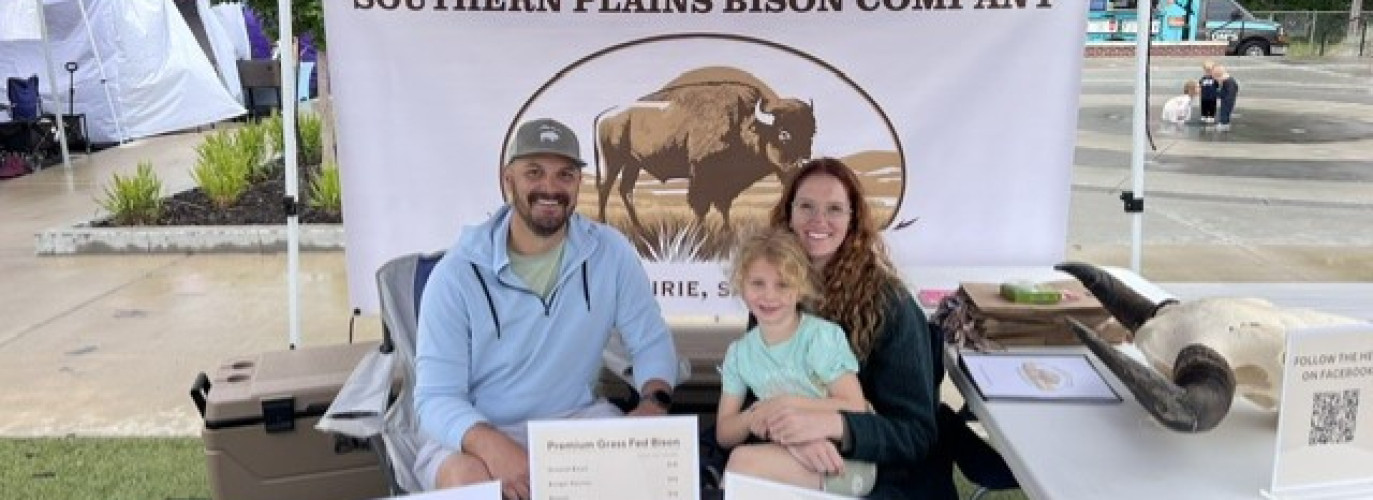
This spring marked their first season at the farmers market, and the turnout surprised them. What started as a rainy morning in Mulvane turned into a steady stream of customers eager to try bison, some for the first time, others returning with stories of past meals. One gentleman bought some ground bison, went home for lunch, decided it was delicious and returned before closing to buy more.
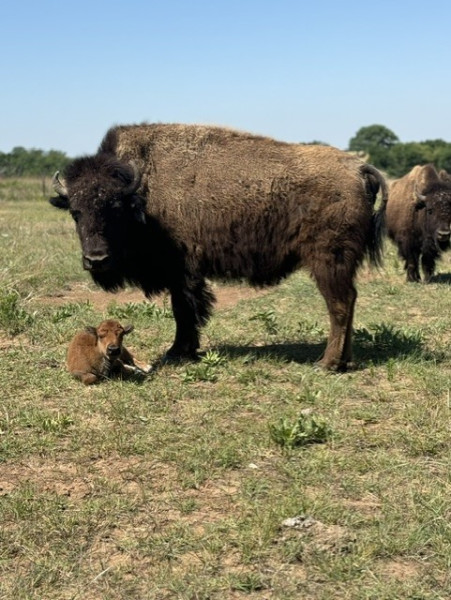
Southern Plains Bison Company maintains about 40 cows, keeping their own replacements. Unlike beef cattle, bison heifers do not breed until age two, which naturally extends the timeline for building the herd. Even so, the process runs smoothly; bison are remarkably easy calvers, with spring calves typically weighing just 30 to 40 pounds and arriving with little to no assistance. Luke and Brooke rotate their herd through summer pastures and supplement with protein pellets from late July through September to support body condition and help the cows breed back for the next year’s calves. New bulls are brought in periodically to maintain strong, diverse genetics.
Their fencing — six strands of barbed wire paired with five‑foot woven wire — reflects the unique nature of bison. Though often described as “somewhere between tame and wild,” Luke says their animals grew up in pasture and know exactly where home is.
On the rare occasion one wanders, a cake truck full of concentrated protein pellets is all it takes to bring them back. Each animal receives both an electronic ID tag and a traditional cattle tag, and their feeding program — grass, corn and silage — improves marbling and turns the fat from yellow to white for better flavor. They also offer both grass‑finished and grain‑finished bison, giving customers the option to choose the flavor profile and finish they prefer. Bulls finish around 30 months, heifers around 36 months, with a target weight of 1,200–1,300 pounds. Processing takes place in Kiowa, at a facility Luke trusts from his own roots in the community.
For years, the family sold calves and yearlings. But after running the numbers, finishing their own animals made far more sense, especially as demand grows for high‑quality, Kansas‑raised protein. Selling by the pound at markets has opened new doors, giving customers a chance to try bison without committing to a quarter or half. Interest in Kansas‑raised foods continues to rise, with consumers looking for protein produced with transparency, care and the same Kansas pride found in both local and conventional operations.
Luke and Brooke are raising their two young daughters, Tristan and Thea, in the same tradition that shaped generations before them. The work is demanding and the timeline is long, but the reward is a thriving herd, a loyal customer base and a future established on the Kansas prairie. In the end, they are not just raising bison — they are building a legacy. And every now and then, something simple, like a child recognizing a bison because of Buffalo Fluffalo, reminds them why this work matters. Southern Plains Bison Company is more than a herd and more than a business; it is a story still being written, one generation, one pasture and one memorable bite at a time.