
Apr 29, 2026
By Stephanie Eckroat
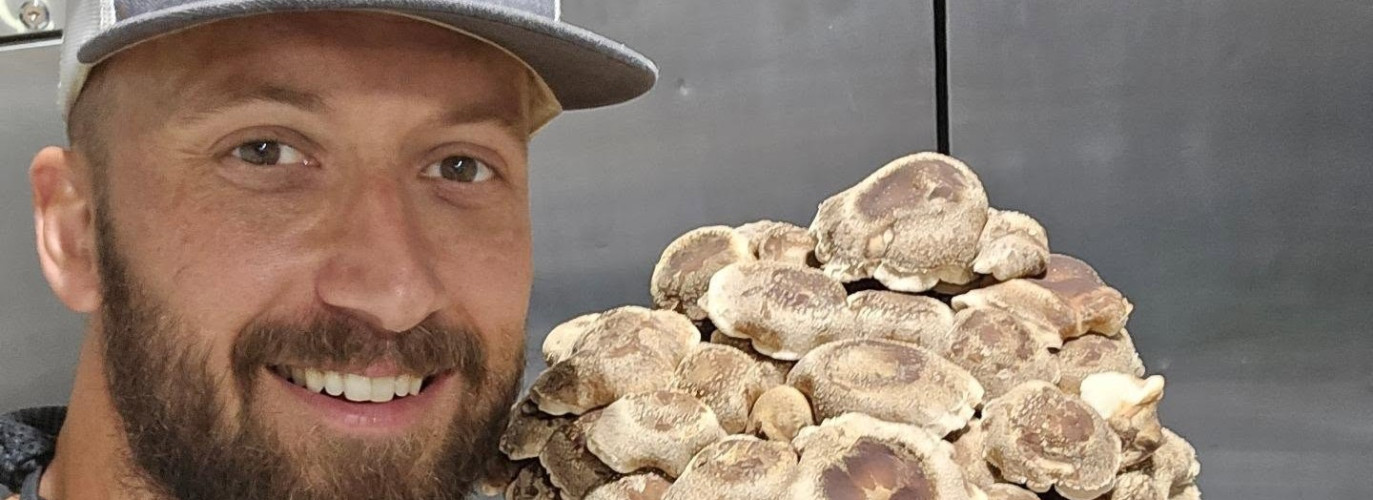
What began as a garage hobby for owner Eric Myers has evolved into a multi-layered business serving customers across the United States and Canada. Today, the operation is tucked behind a modest yellow home along Meridian in Haysville, easy to miss from the street, but anything but small behind the scenes. The backyard has been transformed into a compact, high-efficiency mushroom farm supported by custom-built equipment, much of it designed and fabricated by Myers himself.
A former U.S. Air Force sergeant from New York, Myers describes his journey with a sense of reflection and pride.
“I think the 14- to 15-year-old me would look at current-day me and be pretty proud of where I have gone,” he said.
The business began simply, with mushrooms grown for family use. But production quickly outpaced needs, expanding to 20 to 30 pounds at a time and leading to sales at local farmers markets. As demand grew, restaurants began placing orders, and the rest is history.
Today, Myers Mushrooms runs year-round from a 3,000-square-foot indoor facility. The company has expanded far beyond fresh mushroom production, now including spawn cultivation, equipment manufacturing and a USDA-inspected kitchen and cannery capable of acidified food processing. Approximately 80 percent of revenue now comes from selling specialized mushroom growing equipment to producers across the globe, while fresh mushrooms and spawn account for about 20 percent.
At the heart of the operation is a carefully controlled cultivation system. Production begins with a substrate made from oak pellets, soybean hulls and water packed into breathable filter bags and sterilized for up to 18 hours. Separately, locally sourced milo is sterilized and inoculated with mycelium. Once combined, the materials move into warm, humid colonization rooms where mycelium spread before the bags are transferred to fruiting chambers, triggering mushroom growth.
Depending on the species, such as lion’s mane, oyster, reishi or maitake, the full cycle takes anywhere from two weeks to two months.
Much of the system has been engineered in-house. Myers has designed and built a significant portion of the equipment used throughout the facility, helping the company position itself not only as a grower but also as a manufacturer and educator in indoor agriculture.
“I am an industry leader through influence, making the equipment available and selling it through training,” Myers says. “I am trying to set the tone across the nation and the world for high-tech indoor growing.”
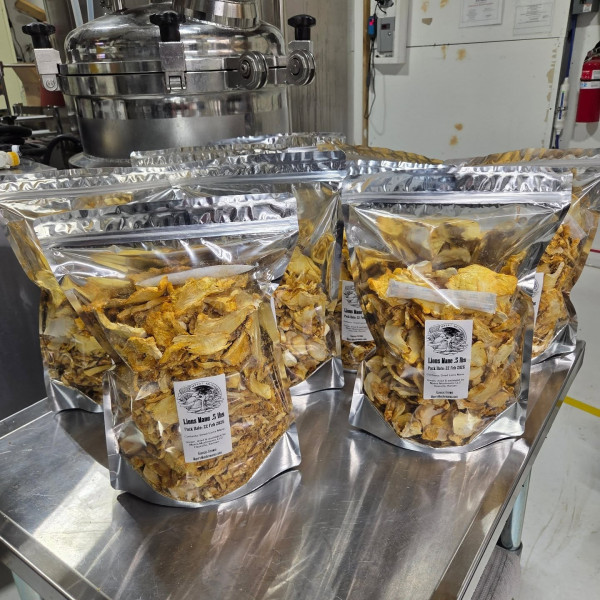
The company also operates a USDA-inspected kitchen launched during the COVID-19 pandemic with grant support. That investment allowed Myers Mushrooms to expand into dehydrated foods and other value-added products. More recently, additional funding has supported extraction equipment, a freeze dryer, and a bottling line — tools that have helped the business enter the growing “food as medicine” market.
One of the company’s standout products is Lion Berry, a tincture combining lion’s mane mushroom extract with elderberry, apple cider vinegar, and local honey.
“We are producing real food — no artificial flavors or colors,” Myers says.
Currently, the operation produces roughly 250 pounds of fresh mushrooms each week for local restaurants and Green Acres Market. The facility also bottles between 2,000 and 4,000 tinctures per month.
Looking ahead, Myers plans to expand further with improvements such as a walk-in cooler to increase efficiency and create additional workspace. He is also exploring partnerships with other local farmers to strengthen regional food systems.
“If we are going to build these food hubs and work together, we need to have more facilities available — and I need to do my part,” he says.
A single spore can go a long way, especially when paired with a garage, a lot of creativity and a knack for building things from scratch. In Haysville, that combination has grown into Myers Mushrooms, where innovation seems to be just as important as humidity and substrate.
Learn more at myersmushrooms.com.